
How Many Words Per Minute Do People Actually Read? The Real Number, From 190 Studies
RomânăA meta-analysis of 190 studies puts average reading speed at 238 words per minute for non-fiction. The real number, where it comes from, and how to test yours.
8 min read

You Ask for a Number and Get Five
You typed the question and got chaos back. One site says 200 words per minute. Another says 250. A third is selling a course and claims that "real speed reading starts at 900."
Search a little further and it doesn't get much better. The first serious-looking result is a listicle quietly copying the same unsourced figure ten other sites already copied. Another, dressed up like a trivia encyclopedia, is actually answering a different question - how fast someone talks, not how fast they read silently.
None of them tells you where the number came from.
It's like asking five people the average height of an adult and getting answers ranging from one metre to three, none of them holding a tape measure.
The question does have a real, measured, published answer. It's less flashy than what the industry sells, which is exactly why nobody repeats it.
What Actually Happens: 238 Words Per Minute
In 2019, Marc Brysbaert pulled together, in a single meta-analysis (a statistical synthesis of every existing study), everything measured on this topic since 1901. For silent reading: 190 studies, 18,573 adult participants.
The result, for non-fiction, is 238 words per minute, with a typical range of 175 to 300. For fiction the average climbs to 260, ranging from 200 to 320.
There's a third figure that gets overlooked. Reading aloud is much slower: 183 words per minute, calculated across another 77 studies.
None of these numbers are arbitrary. They come straight out of how the eye actually moves across a page.
You don't glide smoothly along a line. The eye stops, jumps forward, stops again. Each stop (a fixation) lasts around 250 milliseconds, each jump covers seven or eight letters, and in 10 to 15% of movements you jump backward instead.
Across ten skilled readers measured in a lab, the average was 216 milliseconds per fixation, 8.1 characters per jump, and 11% backward jumps. The resulting speed: 308 words per minute. The arithmetic of eye movement lands on exactly the order of magnitude the meta-analysis reports.
That's why Brysbaert states outright that setting your target at 300 words per minute is unrealistic for most people. In one study where 48 avid readers timed themselves through entire books, the average was 260 - and only 11 of the 48 broke 300.
The 238 Is Mostly an English Number
There's a caveat worth carrying out of the meta-analysis, because it changes how much weight your own score can bear.
That 238 rests on a body of research that is overwhelmingly English-language, and heavily weighted toward university students sitting in a lab. It is the best number anyone has. It is not a number about humans in general.
Where languages have been compared directly, the spread is real but smaller than you'd guess. The meta-analysis puts Italian at 253 words per minute, Spanish at 213, and French at 214, against 238 for English non-fiction. There is even a purpose-built instrument for the comparison: IReST, a set of standardized paragraphs matched for length and difficulty and normed across roughly twenty languages, built so that a reading speed measured in one language means something next to a reading speed measured in another.
The same data holds a counterintuitive detail. Languages that need more words to say the same thing tend to read faster, not slower.
French needs around 1,062 words to translate 1,000 English ones, and still reads at a comparable pace. What stays constant across languages isn't the word count - it's the amount of information transferred per minute.
The practical version, if you read in more than one language: your words per minute in your second language is not comparable to your first, and neither is comparable to a published average drawn from a third. The only comparison that survives contact with reality is you against yourself, on similar text.
What You've Been Told, and Why It's Wrong
Three errors keep circulating around this question. Each one costs you differently.
First: "the average is 200." That's too low. The practical effect is that you think you're below average exactly when you're average, which makes you an easy customer for any promise that comes along.
Second: confusing it with speech. The speed at which you articulate words and the speed at which you read them silently are two different things, and the gap is large: 183 versus 238. An article answering you about speech has answered a different question.
Third: the big numbers. 900 words per minute, 1,000, 2,000, 25,000. It's worth staying calm here, because the problem isn't the size of the number. The problem is that every single time someone also measured comprehension, the big number melted away.
In a controlled evaluation of a speed-reading course, the group's speed rose from around 280 to around 400 words per minute. Comprehension dropped over the same period, from 81% to 74%.
Two graduates the program's own organizers held up as remarkable got through an entire university textbook in six minutes - around 15,000 words per minute. Comprehension was, in the investigator's own words, poor. The only genuinely remarkable skill on display was how fast they could turn pages.
Graduates of one famous speed-reading program - the ones whose gaze moved fastest down the center of the page - answered around 50% correctly on a true-or-false test. Exactly what you'd get flipping a coin.
As for PhotoReading, with its claim of 25,000 words per minute, it has been independently evaluated exactly once, in a report commissioned by NASA Ames.
The two readers tested - one of them an instructor with years of practice - scored 112 words per minute using the technique and 114 reading normally. With 20% less comprehension.
The most authoritative synthesis of the field, a review commissioned by the Association for Psychological Science, reaches the same conclusion: there is no silver bullet.
The trade-off between speed and accuracy is real. And a normal pace, between 200 and 400 words per minute, is, the authors write, good enough for most purposes.
What Works Instead: Effective Speed
Every number so far shares the same flaw. It measures how fast you move through the text, not how much of it is still there after you close the book.
That's why we use a single metric, and it's simple:
Effective Speed = words per minute × comprehension percentage.
Here's a concrete example. Anna reads 450 words per minute and answers half the questions about the text correctly. Her Effective Speed is 450 × 50%, which is 225.
Ben reads 280 words per minute and answers 90% correctly. His Effective Speed is 280 × 90%, which is 252.
On the stopwatch, Anna is over 60% faster. On what actually stuck, Ben is ahead.
It's the difference between two trucks. One pulls into the yard doing 120, having lost half its cargo on the way. The other pulls in at 80, but with everything it loaded.
What matters is what you unload, not how fast you came through the gate.
Both terms in that multiplication can be increased. But the strongest lever isn't the one you'd expect.
Out of an entire battery of cognitive skills tested, the single strongest predictor of reading speed is how fast you recognize words. Not eye strength. Not how wide your visual span is. Word recognition.
And word recognition trains in exactly one way: by reading. The more often you encounter a rare word, the more common it becomes for you - and the cheaper it gets to process.
That explains an otherwise strange result. Tested on technical texts from a field they didn't know, trained speed readers lost their entire advantage over people who were simply skimming.
Their speed was, in large part, knowledge wearing the costume of technique.
So how big are the real gains? Klimovich, Tiffin-Richards and Richter put that question to a controlled test in 2023. Thirty German-speaking undergraduates were split three ways: a commercial, app-based speed-reading training, a single one-hour metacognitive session that did nothing but explain how reading works, and a control group that trained nothing at all.
Afterwards, the app group read at 237 words per minute, the lecture group at 224, and the control group at 195. That's 42 words per minute over control for the app and 29 for the hour of explanation - and the gap between the two trainings was not statistically significant.
Comprehension didn't move at all. All three groups scored 88% on the comprehension check: the app group, the lecture group, and the people who had done nothing.
That result is worth reading in both directions, or you'll misuse it. Nobody lost comprehension, so the trade-off described in the section above did not show up here. But nobody gained any either, and the study runs ten people per group - enough to detect only a very large difference in comprehension, not a subtle one. What it does rule out cleanly is the promise on the box. Not doubling. Not tripling. Forty-two words per minute.
Forty-two words per minute doesn't go on a billboard. But it's real, unlike 900.
One last thing, and the easiest to miss: comprehension isn't estimated, it's tested. The PhotoReading practitioner in the NASA report rated her own understanding of the material at 4.5 out of 5. On the actual physiology exam, she scored 35% on multiple choice, where chance alone gives you 25%.
The feeling of having understood is the worst measuring instrument you own. That's why the comprehension half of the formula gets tested, not self-reported.
How to Measure Your Speed: An Online Test You Can Repeat
The reading speed test at readwizzard.com/test is public, free, and doesn't require an account. Near the end it asks for an email, but you can skip that step and still see your result.
Here's how it works: you pick a topic you're interested in and get a passage of around 400 words, which you read at your own pace.
The timer starts the moment you begin and stops when you tap "I've finished reading." The button only appears on the last page, so you can't skip ahead. Then you answer three questions about what you just read.
The results screen gives you four numbers: raw speed, comprehension percentage, Effective Speed, and your percentile. The percentile is the share of adults you outperform, calculated against the 238 average from Brysbaert's meta-analysis.
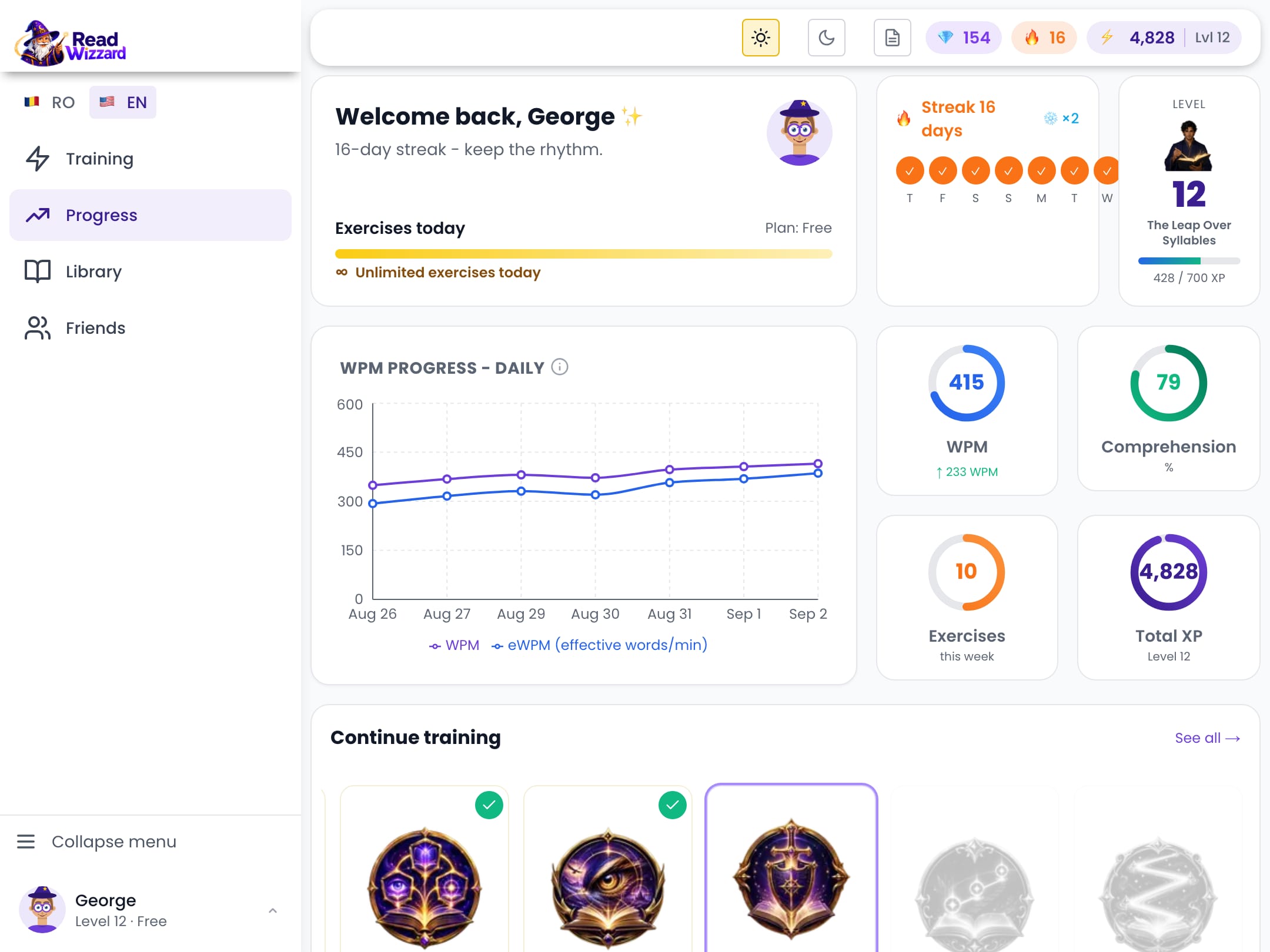
How to read your result without fooling yourself:
- The percentile is an orientation, not a grade. It's measured against a literature that is mostly English-language and mostly university students, as you read above. It tells you roughly where you sit among adults who have been tested. It doesn't grade you.
- A single measurement is a snapshot, not a verdict. Fiction and non-fiction differ by about 20 words per minute even at the level of the average. A tired day counts too.
- The number that matters is Effective Speed. If your raw speed goes up and your comprehension goes down, you haven't gained anything. You've just finished a book earlier that you don't actually have.
- Comparisons only work on text of similar difficulty. Measure again in a few weeks, on something comparable, or you're comparing apples to oranges.
Everything else - which technique you use, what you skip, what you slow down for - only makes sense once you have a number of your own. Without it, any progress is just an impression.