
Why I Reread the Same Sentence (And When You Should)
RomânăRereading isn't a character flaw. Sometimes it's correct repair, sometimes it's attention that left the room. Here's how to tell them apart.
7 min read
You Read the Page and Don't Know What It Said
You get to the bottom of the page and there's nothing in your head.
Your eyes moved over every line. You saw every word. Nothing stuck.
So you go back. You reread the sentence. On the second pass you catch half of it, on the third something clicks. You've just burned four minutes on an eight-line paragraph.
Or the other version. You're reading calmly, no effort at all, and you suddenly realize you've been thinking about something else for the last three lines.
The wording repeats almost word for word on reading forums, where the question always shows up in the first person. I don't retain anything. My mind wanders. I think there's something wrong with me.
Nearly everyone draws the same conclusion, and it's about character. I don't have patience. I'm not built for reading. I probably have a concentration problem.
The conclusion is wrong, and it's wrong in a useful way.
What you're describing isn't one symptom. It's two, and they look identical from the outside while calling for opposite responses.
What Actually Happens When You Go Back
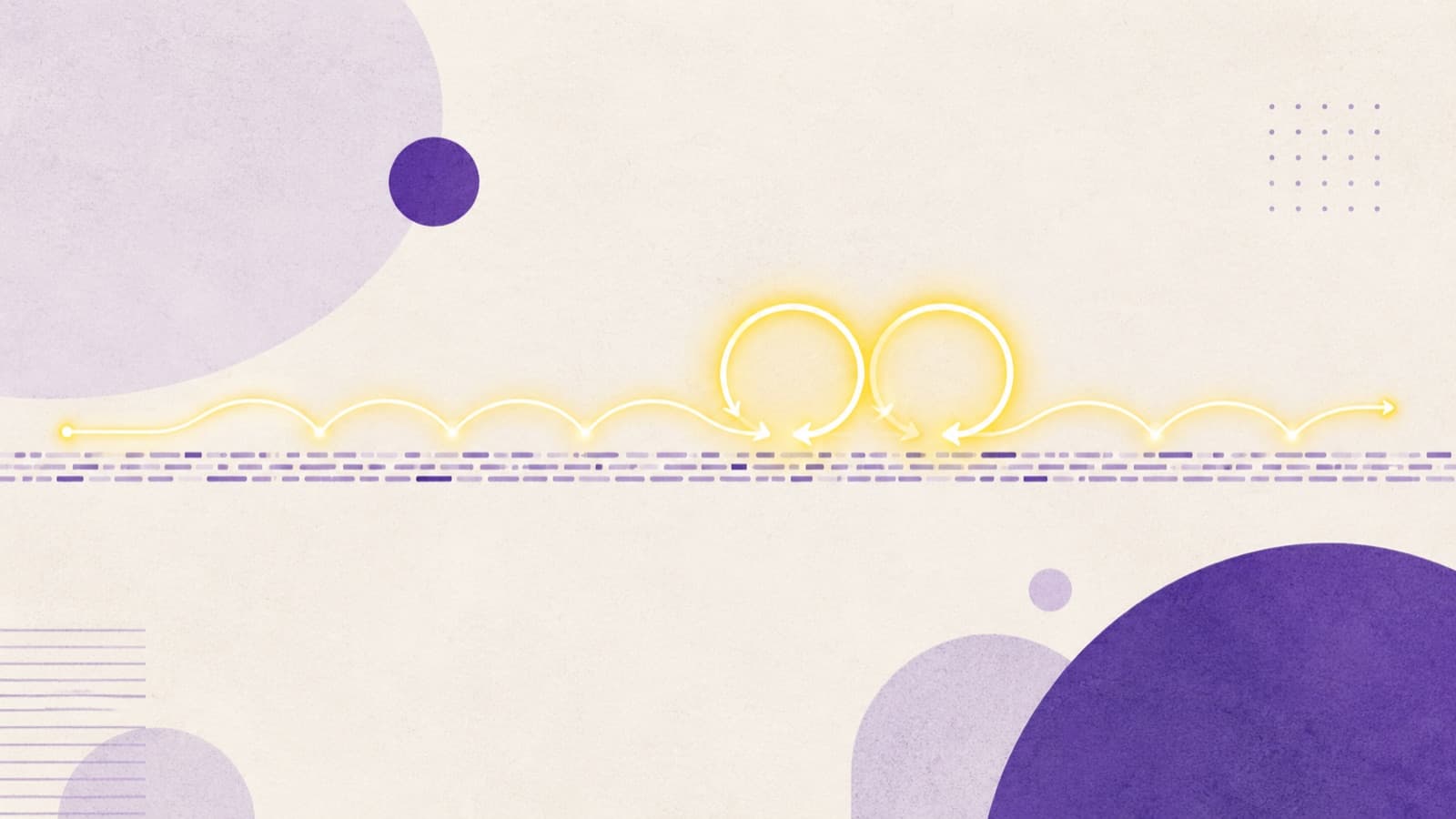
Reading isn't a smooth slide along the line. It's a series of stops.
The eye fixes on a point, sits there for around 250 milliseconds, then jumps seven or eight letters ahead. The stop is called a fixation, the jump is called a saccade.
In 10 to 15 percent of these movements, the jump goes backward. That's a regression: you return to text you've just passed over.
The numbers come from Rayner (1998), the classic synthesis on eye movements in reading, and they're repeated in Rayner et al. (2016), the most complete published review of speed reading.
What matters is what these returns actually are. They're not a malfunction. They're reading's repair mechanism.
The authors say it directly: a regression is more the solution to a confusion than the cause of it.
You read a long sentence where the subject only becomes clear at the end, and the first few words landed wrong. The eye goes back, rebuilds the connection, and you move on. The whole operation takes under a second and you usually don't even notice it.
That's the first case. The second one has nothing to do with the text.
In a study cited by Brysbaert (2019), participants reported task-unrelated thoughts on 42 percent of the sentences in a difficult text. On an easy text, 36 percent (Feng, D'Mello & Graesser, 2013). Reading times went up by almost a second per sentence when the mind wandered.
Nearly half the sentences in a hard text get read by someone who isn't fully there. That's not a pathology. That's how everyone reads.
There are two ways to double back on a road.
One is when you missed the turn, caught the sign too late, and go back to take it properly. The other is when you suddenly realize you've been driving for ten minutes without noticing where you went.
The first turn is navigation. The second means you were on autopilot.
On the page, they look the same. You went back to the same sentence. Underneath, they're two completely different things.
The first is work done correctly. The second doesn't get fixed by rereading better. Rereading is the bill, not the fix.
What You've Been Told About Rereading, and Why It Doesn't Hold
The speed-reading niche treats both kinds of returns as one thing, and a bad one at that.
The version that circulates in courses and blog posts goes something like this. Rereading is a bad habit. It steals up to 30 percent of your time. Get rid of it and you read a lot faster.
There are two problems with that story. The first is the arithmetic.
Regressions are 10 to 15 percent of eye movements, not 30 percent of time. Even if you eliminated all of them, completely and at no cost, the ceiling on the gain stays in the same range.
That's not a doubling of speed. It's the difference between finishing a book in ten hours and finishing it in nine.
The second problem is that eliminating them isn't free, and that's been measured directly.
Schotter, Tran and Rayner published an experiment in 2014, in Psychological Science, that physically blocks rereading. Every word was masked the moment the eye moved past it. The text disappeared behind it.
Comprehension dropped. On ambiguous sentences, where the meaning only becomes clear at the end, accuracy fell to about 50 percent — chance level. With rereading allowed, it was around 75 percent.
The part that's tempting to skip: comprehension also dropped on the control sentences, the ones with no ambiguity at all. It's not just the hard text that pays a price.
The title of their paper is the shortest possible conclusion: don't believe what you read only once.
So rereading isn't what slows you down. On hard text, it's what keeps you on track.
There is a result, though, that shows where the real gain sits, and it isn't in the absence of returns.
Goldman and Saul, cited in Brysbaert's (2019) review, compared readers by where their returns landed. The ones who went back to headings and summaries performed best, 83 percent correct answers. The ones who went back at random ended up no better than the ones who never went back at all.
The target isn't fewer returns. It's better ones.
What Works Instead
The order below isn't arbitrary. The first two don't require any drill, and the last two only make sense once you've done them.
First, the one-second question.
When you catch yourself having gone back over text, pause for a moment. Ask yourself: "did I not understand, or was I not here?"
The answer is almost always obvious, and it points in two opposite directions.
If you didn't understand, go back. You're right to. A hard text gets read with returns, and that's not a technique problem.
If you weren't there, rereading alone doesn't fix anything. You'll go over the line a second time just as absent, unless you change something first.
Second, enter the text with an intention.
For the wandering-attention version, there's a result that surprises everyone.
Klimovich, Tiffin-Richards and Richter compared three groups in 2023. One used a commercial speed-reading app. A second listened to a one-hour lecture on how reading works: fixations, saccades, regressions, and the habit of reading with your mind elsewhere. The third was a control group.
The app group gained about 42 words per minute. The group that only heard the lecture gained 29, and the difference between the two trainings wasn't statistically significant. Neither group lost comprehension.
The study is small, about ten people per group, so treat it as a lead, not a rule. But the direction is hard to ignore: one hour of explanation produced almost as much as five weeks of drills.
Part of the speed you're looking for isn't in your eyes. It's in what you know about how you read, and in knowing why you opened the book in the first place.
Third, the directed return.
When you genuinely need to go back, don't go back to the previous word. Go up to the section heading, to the first sentence of the paragraph, to whatever you noted earlier.
That's exactly the difference Goldman and Saul measured. Same backward movement, different destination, different result.
Fourth, block the reflex.
There's a classic exercise that does literally what it says. You slide a card down over the text you've already read, line by line, as you go. What you've covered disappears underneath it.
You can't go back, because there's nothing left there to go back to. Of everything in this field's toolkit, it's one of the few techniques you can say, without any caveat, does exactly what it promises. It genuinely eliminates regressions, literally.
It also has an effect people notice from the first session. The edge of the card holds your place, so you can't lose your spot at the end of the line. That effect hasn't been tested in isolation in a lab, so it doesn't come with a percentage. It's just mechanically obvious.
What you can't say is that it's a net gain on every text. The calibration is simple:
- On easy, familiar text, where the return is pure reflex, blocking it is a clean win. You lose nothing, because there was nothing to fix.
- On hard text, blocking it costs comprehension. That's exactly what the 2014 experiment measured, which is why the card is a drill, not a permanent way to read.
Which gives you the practical rule. The test of a session with the card isn't the stopwatch. It's what you can say about the text after you've closed the page.
A pace of 280 words per minute at 85 percent comprehension beats 400 at 55 percent. The speed that counts is speed multiplied by comprehension.
How to Practice This, Concretely
To know whether blocking rereading is helping you or hurting you, you need two numbers, not one. How fast you read and how much you understood.
Almost everything sold in this niche measures only the first number. That's also why the numbers in the ads sound so good.
In ReadWizzard, a reading session ends with a comprehension check on the text you just read. That way you see both numbers, not just the flattering one.
The anti-regression drill is there, with the card sliding down line by line, exactly like the paper version. You run it on easy text, in sessions of a few minutes, and check afterward.
Start with the measurement, though, not the drill.
The speed test is public and takes a few minutes. At the end it tells you where you stand against the average from the literature: 238 words per minute for nonfiction, 260 for fiction. The numbers come from a meta-analysis of 190 studies (Brysbaert, 2019).
If you read for pleasure and want to see what the full training path looks like, the page for readers walks through the whole thing.
One thing to keep, if you close the page right now.
Rereading doesn't go away, and it's good that it doesn't. What changes, with training, is that you know why you went back. Because the text asked for it, or because you weren't there.
The first is worth keeping. The second is worth noticing.